
Blog
Aurelian Path Journal
Black vs Brown Medieval Leather Boots: Which Suits Your Costume?

Choosing between black medieval boots and brown leather boots can change the entire mood of a costume. A pair that looks perfect with dark armor may feel too severe with a natural linen tunic, while warm brown leather can bring depth to a Viking-inspired traveler or forest ranger outfit. Neither color is universally more authentic, and color alone tells you nothing about a boot’s comfort or durability.
This guide compares black and brown medieval leather boots for Renaissance fairs, fantasy LARP, cosplay and historical-inspired costumes, then shows how to choose a real product rather than relying on color swatches alone.
When black medieval boots work best
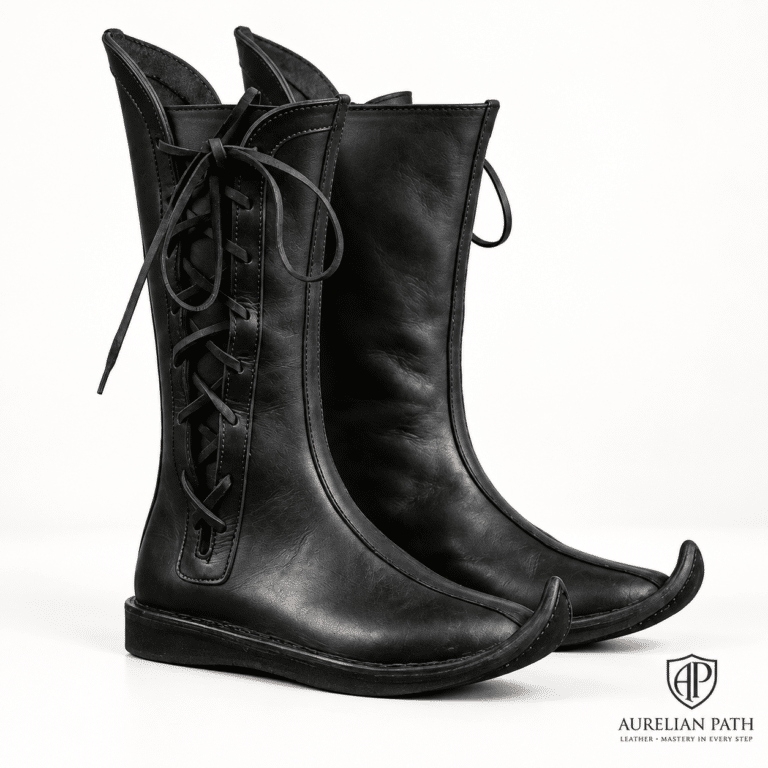
Black boots create a bold outline next to charcoal trousers, dark cloaks and polished or matte costume armor. That makes them a natural visual option for rogues, mercenaries, city guards and fantasy adventurers with a high-contrast wardrobe. Black can also help a detailed belt or colored tunic stand out because the footwear stays relatively neutral.
Look closely at finish, not just color. A glossy black boot and a softly textured black boot will look different under daylight or event lighting. Check product photographs that show the actual leather, stitching, buckles or straps and outsole. Black dye does not guarantee the same leather thickness or construction across different styles.
When brown medieval boots make more sense
Brown boots are a strong match for woodsmen, travelers, Viking-inspired outfits and traditional Ren Faire colors. Brown leather often coordinates naturally with olive, beige, rust, cream, burgundy and faded blue. Its visible tone variations can emphasize natural grain and a handcrafted look, especially alongside woven or textured garments.
Not all brown leather is the same. Honey, chestnut and dark chocolate shades create very different contrasts. Photos taken under warm indoor lights may make leather look redder or lighter than it does outdoors. Review multiple product images before deciding, and expect small natural variations in handmade leather.
Choose by character, not by a simple color rule
Ranger and woodland scout
Brown boots with earth-toned trousers and a green cloak create a natural woodland palette. Black can work for a ranger too, especially with darker layers. For fuller character combinations, see our LARP ranger boots styling ideas.
Knight, guard or mercenary
Black boots can visually tie together darker armor pieces, while dark brown can soften a heavily layered costume. Try the boots with greaves or other costume leg pieces before the event, and make sure nothing catches at the ankles. For contact events, follow safety requirements for armor and footwear.
Viking-inspired traveler
Warm brown often sits comfortably beside natural fabrics, simple leather belts and leg wraps. If you are considering wraps, our guide to medieval boots with leg wraps explains how to keep the layered look secure and comfortable. A costume color palette should not be confused with proof of a specific historical practice.
Compare the actual boots: shape, closure and sole
A color decision is only the beginning. Compare shaft height, the way the upper closes around your leg, how much room there is for socks and whether the sole fits your venue. Some LARP events include long walks on grass or gravel; others take place in halls. Our leather-versus-rubber LARP sole guide explains why the exact outsole matters more than general material labels.
For fit, measure heel-to-toe length and the widest part of both feet. A size that works in modern sneakers may not translate exactly to handmade footwear. If you need a wider fit, contact the maker with measurements rather than simply guessing a larger length.
Two Aurelian Path designs to inspect side by side
Our brown Handmade Medieval Leather Boots are a unisex cowhide design with visible stitching and wrap-lace character. For a dark outfit, view the LARP Medieval Leather Boots, whose product photography shows a black leather style. These are distinct listings; verify each model’s construction, sizes and current availability on its own page.
Both are handmade to order. Check the current production estimates and delivery policy before ordering for a festival. Leave time for an indoor try-on; the right color will not help if the boots cannot be worn comfortably.
Care and aging: will black and brown leather change?
Leather appearance can change through wear, conditioning, sunlight and exposure to moisture. Dust may be more visible on some dark finishes, while scuffs can contrast strongly against dyed leather. Brown surfaces may show changing highlights or grain more prominently. Actual behavior depends on the finish, so do not assume all black or brown boots age identically.
After an event, remove loose dirt, let damp footwear dry naturally and use leather-care products suitable for the specific finish. Avoid soaking, direct heat and untested conditioners. See our medieval leather boots care guide for a simple routine.
Frequently asked questions
Are black medieval boots historically accurate?
It depends on the specific time, location, garment and reconstruction standard. For fantasy LARP and Ren Faire costumes, black is a style choice; stricter historical events may require documented materials and methods.
Are black or brown leather boots easier to match?
Black coordinates easily with dark costumes, while brown blends naturally with earthy, rustic outfits. Set your trousers, tunic and belt side by side before choosing.
Does the boot color affect grip or comfort?
No reliable conclusion about comfort or traction can be drawn from color alone. Fit, construction, sole and the ground surface are the meaningful details to check.
Find your color and fit: See the brown handmade medieval boots and black LARP leather boots to compare the real styles before you order.
Handmade historical footwear
Found the Style You Want?
Explore the current footwear collections and check your measurements before choosing a size.
Keep reading
 Ren Faire Boots Order-By Calendar: Plan Your Event Season