
Blog
Aurelian Path Journal
Medieval Boot Sizing Guide: How to Measure, Including Women
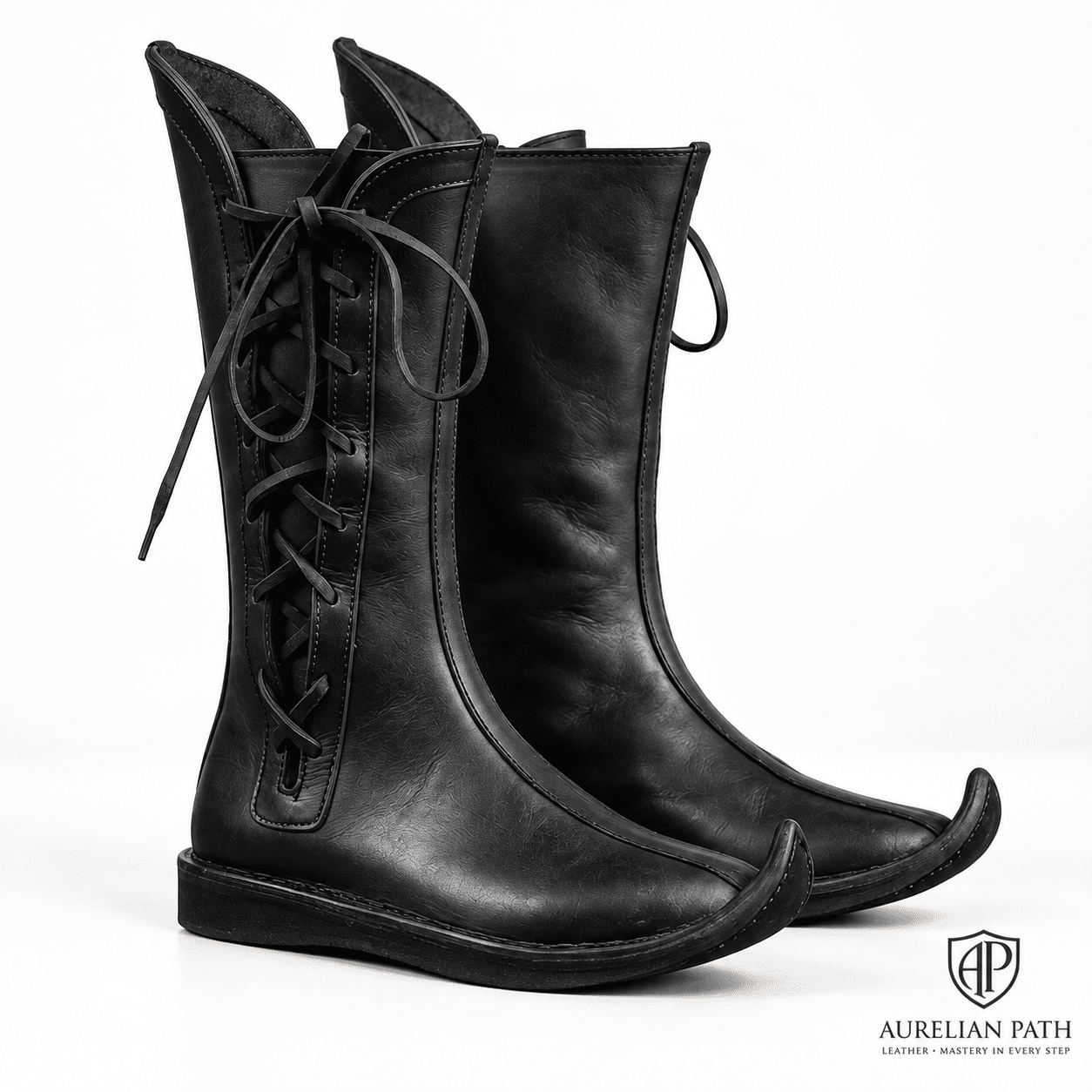
Handmade medieval boots are often bought for a date that matters: a first Ren Faire, a LARP weekend, a wedding or a historical event. The easiest mistake is treating the printed size as a perfect prediction of fit. It isn’t. Leather shape, toe design, socks and the height of the shaft all affect how a pair feels.
Medieval boot sizing guide for women
Women buying a unisex or men’s-labeled boot should use measurements and the chart for that exact model. Do not subtract a fixed number from a women’s size and treat the result as a confirmed fit. Brands differ, and a conversion does not describe heel shape, forefoot width or instep volume.
- Measure both foot lengths wearing the socks intended for the event.
- Record forefoot width using the seller’s method and label the units.
- State the sizing system of your usual shoes: US women’s, UK or EU.
- Describe narrow heels, wide toes, a high instep or inserts.
- For tall boots, measure the calf over the intended trouser layer.
- Ask the seller to confirm the exact listing size before ordering.
For example, a person who normally buys US women’s footwear should send that label as context alongside the measured lengths. The seller can then interpret its own chart; a generic internet conversion should not replace that step.
Foot width and calf width are separate
A roomy shaft does not establish that the forefoot fits. Read medieval boots for wide feet for pressure-point and width questions. Tell the maker whether the problem is at the toe box, instep, heel or shaft instead of asking only for a bigger size.
Try your chosen model indoors first
Compare the measurements with our Ren Faire and LARP Leather Boots and ask about the current fit options. When they arrive, try both boots on a clean surface. Check walking and sitting before outdoor wear, and read the applicable return terms before altering or treating them.
For styling, see women’s medieval ranger boots. For planning, use the event-season ordering calendar to allow time for these checks.
Use this medieval boot sizing guide to collect measurements a shoemaker can actually use, then confirm the appropriate size with the chart for the pair you want. No general chart can replace the dimensions of an individual design.
Step 1: Measure both feet while standing
Place paper against a wall and stand on it with your heel lightly touching the wall. Mark the longest toe and measure from the wall to that mark. Repeat with the other foot. Take measurements at the end of the day if your feet tend to swell, and wear the socks you would use at the event. Use the longer foot as your starting point.
- Record the left and right heel-to-toe lengths in centimeters.
- Measure each foot’s widest forefoot dimension following the seller’s instructions.
- Note whether you normally need a wide fitting or room at the toe box.
- Tell the maker about inserts or orthotics you plan to use.
- Do not trace a curved pencil outline and mistake that for a direct measurement without following the maker’s method.
Step 2: Understand length versus width
If you usually wear US 10W, the ‘W’ describes a width category in a sizing system, not your precise forefoot measurement. Going to a US 11 may increase length without solving pressure at the ball of the foot. Equally, choosing a narrow shape because the foot length matches can pinch even if the toe tip has room.
A secure heel, enough space to move your toes, and an instep that fastens comfortably are all relevant. When communicating with a handmade-boot seller, describe the fit of a pair you already own: where it is snug, where it slips and how much sock thickness you intend to wear.
Step 3: Check instep and ankle closure
A boot can match your length and width but still feel difficult to put on. Instep height affects entry, especially with pull-on styles or limited openings. Lace-up and toggle designs can offer adjustment, but the construction determines how much. Ask whether the boot opens far enough and whether closure straps have room to spare.
Step 4: Measure calf fit for taller boots
Sit and stand while considering where the top of the boot will reach. Measure the leg circumference at that exact height with the trouser layer you intend to tuck inside. The widest part of the calf may sit above or below the boot opening. If this is a frequent fit challenge, read our wide-calf medieval boots guide. Ask for both shaft height and inside opening circumference on the style you are considering.
For example, a calf measuring 18 inches at its widest point does not automatically rule out all boots: a lower shaft may end beneath it. But an 18-inch calf also does not mean every adjustable shaft will fit. Actual dimensions must decide.
Step 5: Use conversion charts cautiously
US, UK and EU labels can be useful for shortlisting sizes, but brands convert them differently. Women’s and men’s charts are not interchangeable without checking the manufacturer’s guidance. Use foot measurements and the model-specific chart first, then contact the seller if your numbers sit near a boundary. Avoid automatically adding a full size for thick socks.
Questions to send the maker
- What is the recommended size for my left/right length and forefoot width?
- Can this exact model accommodate a wide forefoot or high instep?
- What are the shaft height and opening circumference?
- Can I wear my intended socks or orthotics with this design?
- What happens if a made-to-order size is unsuitable?
Example: sizing support from a specialist store
You can use the checklist when contacting the team behind Old Realm Leather’s handmade medieval boots. Their product page invites buyers with wide feet or sizing uncertainty to send length and width before ordering. Check the latest fit, production and returns details for the exact pair rather than relying on generic conversions.
What if one foot is longer?
Use the longer foot as the starting length and share both measurements with the seller. Do not conceal a meaningful difference, especially when choosing close-fitting leather footwear.
How much space should be in front of the toes?
There is no single universal number that works for every medieval toe shape and fitting method. Ask the maker what internal length its chart assumes and confirm that your toes are not compressed.
If you also need help selecting a character style, see the Ren Faire footwear guide.
Handmade historical footwear
Found the Style You Want?
Explore the current footwear collections and check your measurements before choosing a size.
Keep reading
 Ren Faire Boots Order-By Calendar: Plan Your Event Season